- Export Compliance
- MPI Certification
- Risk Mitigation
How to Fix Common MPI Export Certificate Errors in New Zealand (2026)
What to do when your MPI export certificate has an error — consignee mistakes, administrative discrepancies, replacement procedures, and how to prevent certificate problems before your shipment departs.
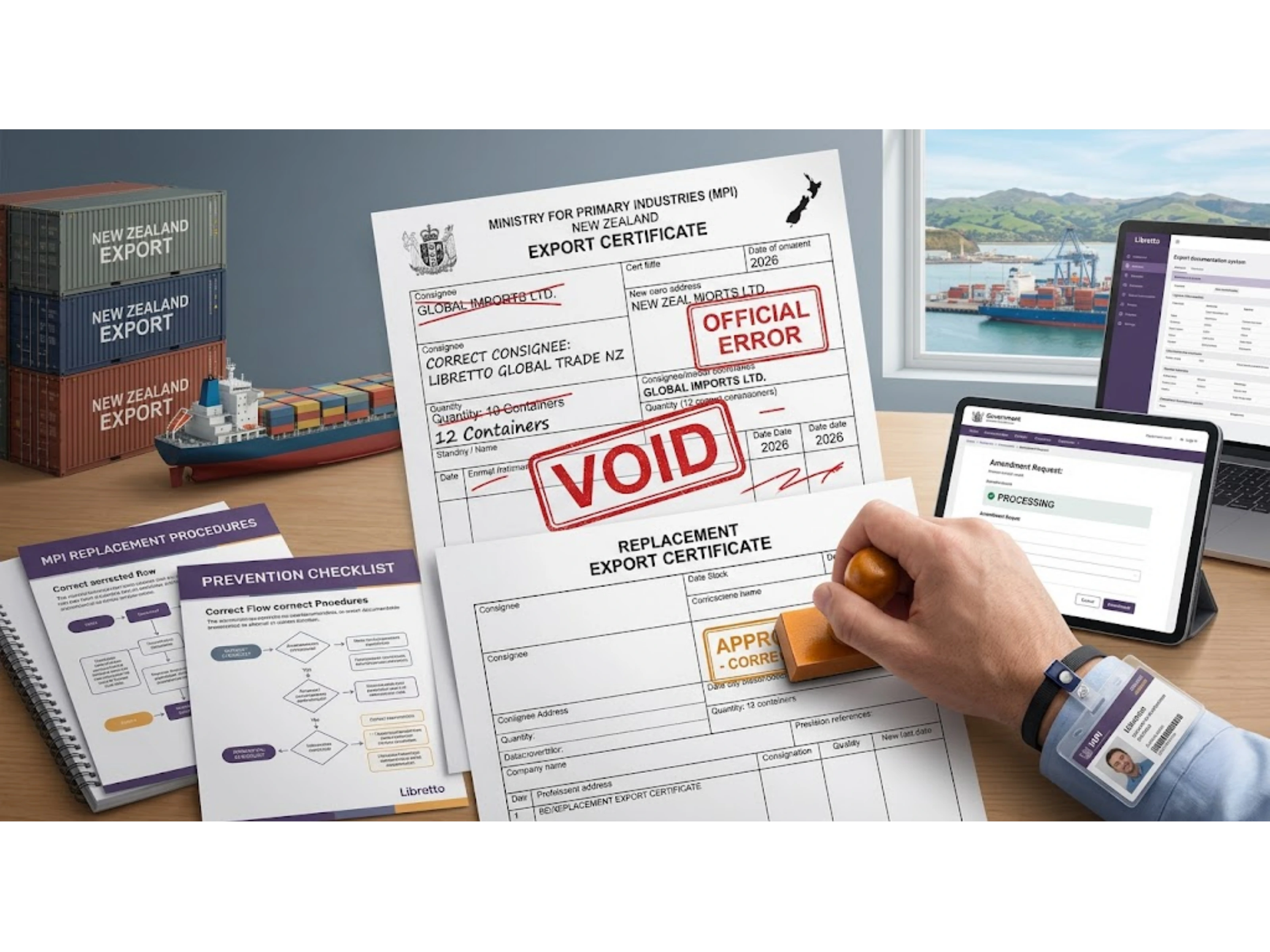
You’ve Found an Error on Your MPI Certificate. Now What?
Your MPI export certificate has the wrong consignee name. Or the product description doesn’t match your commercial invoice. Or the certificate number on your health certificate doesn’t align with what your buyer’s customs broker is expecting. Your shipment is booked, the container is packed, and you need this fixed.
Here’s the immediate answer: MPI has a replacement certificate process through MPI Trade Certification. Your options and timeline depend on two things — the type of error and whether your goods have already shipped.
This guide covers the most common MPI certificate errors, how the replacement process works, what to do if your shipment is already on the water, and how to prevent these problems from occurring in the first place.
The Most Common MPI Certificate Errors
After working with hundreds of export shipments across meat, dairy, seafood, honey, and plant products, certain errors appear repeatedly. Knowing which category your error falls into determines how quickly and easily it can be resolved.
Consignee Name or Address Errors
The most frequent — and often the most consequential — certificate error. The consignee on your MPI certificate must match the consignee on your Bill of Lading, commercial invoice, and any Letter of Credit documentation. Even minor discrepancies can cause problems.
Common scenarios:
- The buyer’s company name is misspelled or abbreviated differently across documents
- A shipment was originally destined for one buyer but was redirected to another before departure
- The buyer’s registered import entity is different from their trading name, and the wrong one was used
- The consignee address has changed since the certificate application was submitted
Consignee errors are particularly serious because importing country customs authorities cross-reference the MPI certificate against shipping documents. A mismatch triggers a hold — and in markets like China, resolving a consignee discrepancy after arrival can take weeks.
Administrative Errors
These are errors in the certificate’s administrative fields rather than its regulatory content:
- Incorrect dates (certificate date, production date, or expiry date)
- Wrong certificate or reference numbers
- Incorrect exporter details (your own company name or registration number)
- Typographical errors in establishment numbers or plant codes
- Vessel name or voyage number that changed after the certificate was issued
Administrative errors are generally easier to correct than consignee errors, but they still require a formal replacement through MPI. You cannot simply amend a certificate yourself — it’s an official government document.
Product Description Discrepancies
MPI certificates describe your product in specific regulatory language. Problems arise when this language doesn’t align with how the product is described on your commercial documents:
- The certificate says “frozen boneless beef” but your commercial invoice says “frozen beef cuts, boneless”
- Weight or quantity on the certificate doesn’t match the packing list
- The HS code referenced on supporting documents doesn’t correspond to the product category on the certificate
- The product grade, class, or specification is described differently across documents
These discrepancies often originate not from the MPI certificate itself being wrong, but from inconsistencies in the commercial documents that were prepared separately. The certificate was issued correctly based on what MPI was told — but what MPI was told doesn’t match what the freight forwarder put on the Bill of Lading.
Establishment or Plant Number Errors
For animal product exports (meat, dairy, seafood), the producing or processing establishment must be listed with the importing country’s competent authority. The establishment number on the MPI certificate must match exactly.
Errors occur when:
- A facility has been re-registered and the old number was used
- Product was processed at multiple facilities and the wrong one was listed
- The importing country uses a different numbering system than MPI’s internal records
- A recently approved establishment doesn’t yet appear in the destination country’s approved list
Establishment number errors are among the hardest to resolve quickly because they can’t always be fixed with a simple certificate replacement — if the establishment isn’t listed by the importing country, no certificate correction will clear the goods.
How MPI’s Certificate Replacement Process Works
When you identify an error on an MPI certificate, the correction process goes through MPI Trade Certification (or the legacy AP E-cert/ePhyto systems if your product category hasn’t migrated yet — though animal products transition in April 2026 and plant products transitioned in March 2026).
Before Your Shipment Departs
If you catch the error before the goods leave New Zealand, the process is relatively straightforward:
- Contact MPI’s certification team through the Trade Certification portal or by phone. Identify the certificate number and the specific error.
- Request a replacement certificate. MPI will need the original certificate details, the correction required, and supporting documentation (e.g., the correct commercial invoice showing the right consignee).
- MPI reviews and issues the replacement. The replacement certificate is linked to the original — it doesn’t pretend the original never existed. The replacement will carry its own certificate number and reference the original.
- Update your shipping documentation. Ensure the new certificate number is reflected on your Bill of Lading instructions and any other documents that reference the certificate.
Typical turnaround: For straightforward administrative corrections, MPI can often issue replacement certificates within 1–2 working days. Complex cases — particularly those involving establishment listings or market-specific requirements — may take longer.
After Your Shipment Has Departed
This is the more stressful scenario. Your container is on the water, and you’ve discovered the error — or worse, your buyer’s customs broker has flagged it at the destination port.
The process is similar, but the stakes and urgency are higher:
- Contact MPI immediately. Explain that the shipment is in transit and the certificate needs correction before arrival.
- Coordinate with your buyer. Their customs broker needs to know a replacement certificate is being issued. In some cases, the customs broker can request a temporary hold rather than an outright rejection while the replacement is processed.
- Determine how the replacement can be transmitted. This varies by market and certificate type. Some countries accept electronic certificates transmitted through MPI’s systems. Others require a physical wet-stamped certificate to be couriered. Check with MPI which method your destination country accepts.
- Factor in the timeline. A container from New Zealand to Southeast Asia takes roughly 10–14 days by sea. To China, 14–18 days. To Europe, 25–35 days. You may have a window to get the replacement issued and transmitted before the vessel arrives — or you may not.
Critical point: Replacement certificates are flagged as replacements. The importing country’s competent authority can see that the original was replaced. In most cases this is accepted without issue, but some markets — particularly those with bilateral agreements that specify exact certificate procedures — may require additional explanation or documentation. The longer the delay between the original and the replacement, the more scrutiny it may attract.
Consignee Errors: A Deeper Look
Consignee mismatches deserve special attention because they’re the error type most likely to result in your goods being physically held at the destination port, and because the fix isn’t always as simple as issuing a replacement certificate.
Why Consignee Errors Happen
The consignee on an MPI certificate is typically set at the time the certificate application is submitted — which may be days or weeks before the shipment actually departs. In that gap, things change:
- The buyer requests the shipment be redirected to a different entity (common in commodity trading where goods are sold on while in transit)
- The buyer’s import licence is held by a different legal entity than the one named in the purchase order
- The freight forwarder uses the notify party instead of the actual consignee when lodging shipping documents
- A simple copy-paste error from a previous shipment that had a different buyer
Market-Specific Risks
Not all destination markets treat consignee discrepancies equally:
China is the strictest major market for New Zealand exporters. China’s General Administration of Customs (GACC) cross-references MPI certificates against import declarations rigorously. A consignee mismatch can result in goods being quarantined, and resolution typically requires diplomatic-level communication between MPI and GACC. This can take weeks. For high-value shipments of meat or dairy to China, getting the consignee right the first time is non-negotiable.
European Union member states generally have a more structured amendment process through the TRACES system. If the consignee on the health certificate doesn’t match the import declaration, the border inspection post may contact the exporting country’s competent authority (MPI) directly to verify. This adds days but is usually resolvable.
Southeast Asian markets vary significantly. Some are relatively flexible on minor discrepancies; others enforce strict matching. Check the specific requirements for your destination before assuming a small error won’t matter.
Middle Eastern markets that require consular legalisation add another layer of complexity — a certificate replacement may also require re-legalisation through the relevant embassy or consulate.
Prevention Is Significantly Cheaper Than Correction
The cost of correcting a consignee error after shipment — factoring in MPI replacement fees, potential demurrage at the destination port, buyer penalties for delayed delivery, and the staff time spent managing the crisis — typically runs into thousands of dollars. For perishable goods like chilled meat or fresh seafood, the entire shipment may be at risk if the delay extends beyond the product’s shelf life.
Compare that to the cost of checking that the consignee details match across all documents before the certificate application is submitted.
Preventing Certificate Errors Before They Happen
The most effective — and cheapest — approach to MPI certificate errors is to catch them before the certificate is issued. Once a certificate exists, correction requires MPI’s formal replacement process. Before it exists, you simply fix the input.
Build a Pre-Submission Checklist
Before submitting any MPI certificate application, verify the following against your commercial documents (commercial invoice, packing list, Bill of Lading draft):
- Consignee: Full legal name and address matches exactly across all documents. No abbreviations on one and full name on another. No trading name on the certificate and registered name on the invoice.
- Product description: The regulatory description MPI will use aligns with how the product is described commercially. They don’t need to be identical, but they must be clearly referring to the same product.
- Weights and quantities: Net weight, gross weight, and number of packages are consistent. MPI certificates may express quantities differently from commercial documents — verify the equivalence.
- Establishment numbers: The producing/processing facility number is current and matches the importing country’s approved list. Check MPI’s register if you’re unsure.
- Vessel and container details: If these are included on the certificate (common for health certificates), confirm they match the Bill of Lading.
- Dates: Production dates, inspection dates, and intended shipment dates are all consistent and within validity windows.
Cross-Reference Against Letter of Credit Terms
If your shipment is under a Letter of Credit, the documentary requirements become even more demanding. The L/C may specify the exact format of the MPI certificate, including the consignee name, the document title, the number of originals required, and specific clauses that must appear.
A certificate that satisfies MPI but doesn’t match the L/C terms will pass customs but fail at the bank — and that’s a different kind of expensive mistake. For L/C shipments, review the certificate against the L/C requirements as well as the commercial documents.
For a detailed breakdown of L/C document requirements, see our complete guide to export documentation from New Zealand.
Why Independent Review Catches What Internal Checks Miss
Most certificate errors don’t happen because the exporter is careless. They happen because the same person — or the same small team — is preparing the commercial documents, instructing the freight forwarder, and submitting the MPI certificate application. When you’ve been looking at the same shipment details for three days, you develop blind spots. You read what you expect to see, not what’s actually there.
This is the same reason law firms have different lawyers draft and review contracts, and the same reason accounting firms separate preparation from audit. Independence isn’t about competence — it’s about catching the errors that familiarity makes invisible.
An independent document review checks your entire documentation set — commercial documents, shipping instructions, and certificate applications — for consistency before anything is submitted. The reviewer hasn’t been involved in preparing the documents, so they see discrepancies that the preparer’s eyes skip over.
What to Do Right Now If Your Certificate Has an Error
If you’re reading this because you’ve got a certificate with an error and a shipment that needs to move, here’s the immediate action plan:
Step 1: Identify exactly what’s wrong. Compare the certificate against your commercial invoice, packing list, and Bill of Lading. Note every discrepancy, not just the one you first spotted — there may be more.
Step 2: Determine your timeline. Has the shipment departed? When does it arrive? What’s the latest the replacement certificate can reach the destination before your goods need to clear customs?
Step 3: Contact MPI’s certification team. Have the certificate number, the specific errors, and corrected details ready. If the shipment is in transit, make that clear — urgency affects processing priority.
Step 4: Notify your buyer and their customs broker. They need to know a replacement is coming and may need to coordinate with the destination port authority.
Step 5: Follow up. Don’t assume the replacement is processing — confirm it’s been received, is being actioned, and will be completed within your timeline.
If you need help navigating the replacement process, or if you want to prevent this from happening on your next shipment, our document review service catches exactly these kinds of errors before your documents are submitted — before they become expensive problems to fix.
The Cost of Getting It Wrong vs. Getting It Checked
The mathematics are straightforward. An MPI certificate replacement, when everything goes smoothly, costs time and administrative effort. When it doesn’t go smoothly — when goods are held at the port, when demurrage charges accumulate, when a buyer in China has to wait three weeks for GACC to accept a corrected certificate — the total cost can easily exceed $5,000–$15,000 for a single shipment.
A document review before your shipment departs costs $80 for standard shipments, $200 for Letter of Credit shipments. The review checks every document in your set — including MPI certificate applications — for exactly the kinds of errors described in this guide.
You don’t need to use a review service for every shipment you ever make. But for new markets, new buyers, high-value consignments, and any shipment under a Letter of Credit, the cost of checking is a fraction of the cost of correcting.
Not sure what documents your shipment requires in the first place? Start with our complete guide to export documentation from New Zealand or our MPI export requirements guide. And if you’re new to exporting entirely, our step-by-step guide for first-time exporters walks you through the whole process.
Get Your Documents Reviewed Before You Ship →
About Libretto
Libretto provides export documentation services and independent document review for New Zealand exporters. From document preparation and MPI certification to pre-shipment compliance checks, we help exporters across meat, dairy, seafood, honey, and horticulture get their paperwork right — before it reaches customs or the bank.
Ready to export? Let's talk.
Whether you're an experienced exporter looking for better documentation support or a grower making your first international shipment — let's talk.